How Much Does Equipment Really Cost Per Hour? A 3,500-Hour Contractor Example
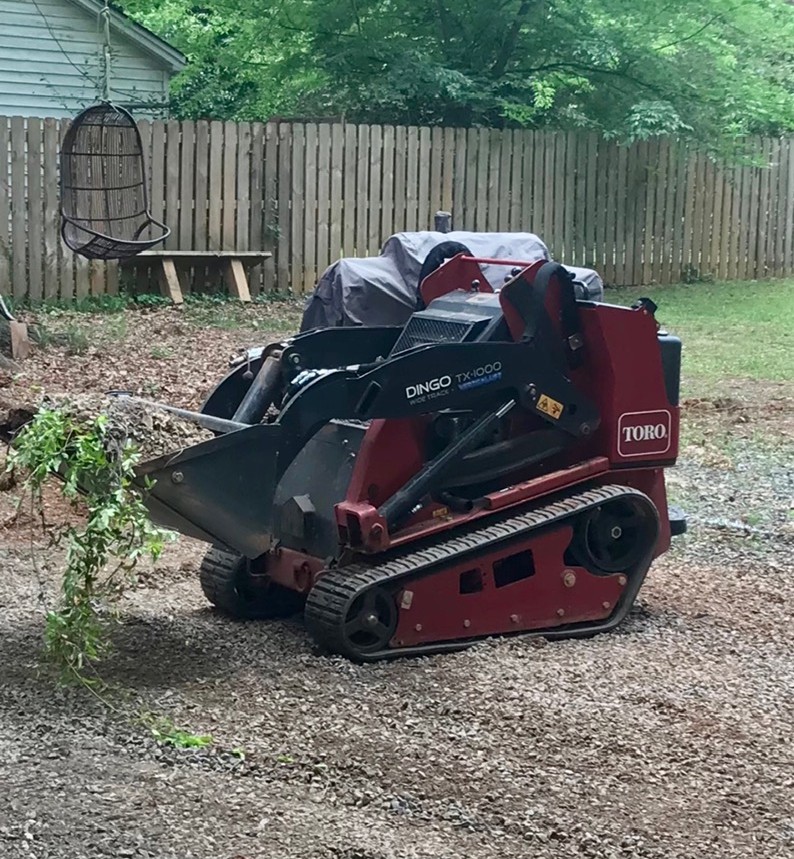
I bought a new 2019 Toro Dingo TX 1000 Wide Track for about $35,000. Today it has roughly 3,500 hours on it, it is completely paid off, and comparable used machines with similar age and hours appear to be worth somewhere around $15,000 to $20,000.
So what has that machine actually cost my contracting business per hour?
That question is harder to answer than simply dividing the purchase price by the hours on the meter. Equipment has residual value. It burns fuel. Tracks wear out. Parts break. Maintenance takes time. Insurance costs money. And eventually, even a paid-off machine has to be replaced.
In this article, I’m going to use our actual machine and roughly seven years of ownership experience to show how I think contractors should approach equipment cost per hour—including where our records are precise and where they aren’t.
Our Real Contractor Example
- Machine: 2019 Toro Dingo TX 1000 Wide Track
- Purchased: New
- Purchase price: Approximately $35,000
- Financing: 0% for 4 years
- Original hours: 0
- Current hours: Approximately 3,500
- Estimated current value: Approximately $15,000–$20,000 based on comparable used machines we see for sale
- Typical current use: Approximately 300–400 hours per year
Purchase Price Divided by Hours Is Not the Whole Story
The easiest calculation would be:
But I don’t think $10 per hour accurately describes what the machine has cost us.
The biggest problem is that we still own the Dingo. It hasn’t lost its entire $35,000 purchase price. Based on comparable used machines we’ve seen with similar age and hours, I estimate ours could currently be worth somewhere around $15,000 to $20,000.
Using the midpoint of that range—$17,500—gives us an estimated depreciation calculation of:
Using a $17,500 estimated current value and approximately 3,500 operating hours.
That’s a much different number from $10 per hour.
It also illustrates why residual value matters when calculating equipment cost. A machine that still has substantial resale value has not consumed its entire original purchase price.
The $17,500 value used here is my own midpoint estimate based on comparable used equipment we see for sale. It is not a formal appraisal.
What About the $730 Monthly Equipment Payment?
We financed the Dingo for four years at 0% interest. The payment was roughly $730 per month.
It’s tempting to use that monthly payment as the machine’s cost, but I don’t think that’s the right way to calculate equipment cost for estimating.
The payment affected our cash flow. It told us how much money left the bank every month. But because the financing was 0%, it didn’t add meaningful interest expense to the $35,000 purchase price.
And now the machine is paid off.
That doesn’t mean the Dingo suddenly costs us nothing to use.
Paid Off Does Not Mean Free
A paid-off piece of equipment still depreciates, consumes fuel, needs maintenance, wears out parts, requires insurance and will eventually need to be replaced.
If I treated a paid-off machine as having no equipment cost when estimating jobs, I would be understating what it really costs the company to perform the work.
Track Cost Has Been One of Our Biggest Wear Items
We’ve gone through approximately three sets of tracks in 3,500 hours—the original tracks plus two replacement sets.
The aftermarket replacement tracks we’ve purchased are roughly $1,200 per set.
That gives us approximately:
$2,400 ÷ 3,500 Hours = $0.69 Per Hour
Track life depends heavily on how the machine is operated.
We try to avoid running the Dingo on asphalt more than necessary. More importantly, we try to avoid making zero turns on asphalt. A tracked machine can eat through expensive tracks surprisingly quickly when it’s constantly turning on hard surfaces.
I wouldn’t assume another contractor will get exactly the same track life we have. The point is to use your actual replacement history whenever possible.
Maintenance Labor Is Still a Cost—even When I Do It Myself
One thing we’ve liked about this Dingo is that we’ve never had to take it to a shop for routine maintenance.
If you’re comfortable performing basic maintenance on something like a commercial mower, most of the routine maintenance on our Dingo has been manageable.
Over the life of the machine, I estimate we’ve spent roughly 50 hours of our own time performing maintenance.
I don’t think that labor should be valued at $0 just because we did the work ourselves.
If I value that time at $60 per hour:
$3,000 ÷ 3,500 Machine Hours = $0.86 Per Operating Hour
Our regular maintenance has included engine oil changes, hydraulic-fluid service, greasing the machine, filters and other routine items.
Greasing is especially important. There are numerous grease fittings on the machine, and we’ve tried to stay on top of them. We also regularly drain water from the fuel/water separator. In my experience, the machine simply runs better when the basic maintenance isn’t ignored.
One annoying recurring item has been the throttle cable. Ours seems to break roughly every year or two, and getting the replacement adjusted correctly can be frustrating.
We have not tracked every quart of oil, filter, tube of grease, throttle cable and gallon of hydraulic fluid over seven years. Rather than invent a number, I’m leaving those routine parts and fluids out of the documented calculation below.
Our Biggest Repair Has Been Relatively Minor
For a machine with approximately 3,500 hours, ours has been very reliable.
The biggest repair I can remember was a leaking lift cylinder around four years ago. That repair cost us approximately $1,200 at the time.
Other than that, we haven’t experienced major engine problems, hydrostatic-system failures or significant engine leaks.
That doesn’t mean the next 3,500 hours will look the same. Equipment repair costs tend to become less predictable as machines age, which is another reason I wouldn’t use historical repair expense alone to determine what an older machine should cost in future estimates.
Our Documented Cost Is About $6.89 Per Hour—but I Wouldn’t Estimate Jobs With That Number
If I total only the larger costs that I can reasonably reconstruct from our ownership experience, the calculation looks like this:
| Cost | Approx. Lifetime Cost | Cost Per Machine Hour |
|---|---|---|
| Economic depreciation to date | $17,500 | $5.00 |
| Two replacement track sets | $2,400 | $0.69 |
| Owner/company maintenance labor | $3,000 | $0.86 |
| Major cylinder repair | $1,200 | $0.34 |
| Known / Estimated Total | $24,100 | $6.89/hr |
This is NOT what I would consider the machine’s complete operating cost.
That last sentence is important.
I would not put $6.89 per hour into an estimate and assume I’ve covered the Dingo.
That number excludes several real costs because I don’t have reliable historical records for them.
What’s Missing From the $6.89 Per Hour?
The biggest missing items are:
- Diesel fuel
- Engine oil and filters
- Hydraulic fluid and filters
- Grease and miscellaneous maintenance supplies
- Throttle cables and smaller replacement parts
- The Dingo’s share of our inland-marine insurance policy
- Future repairs as the machine continues to age
- The future cost of replacing the machine
Fuel is an especially obvious omission. We know how much diesel we buy as a company, but we’ve never tracked exactly how many gallons this particular machine burns per operating hour.
I’d rather admit that than plug an assumed fuel-consumption number into a “real contractor example” and pretend it came from our records.
Precision Is Not the Same as Accuracy
A spreadsheet can produce an equipment cost of $18.47 per hour down to the penny. But if half of the inputs are guesses, the extra decimal places don’t make the answer more accurate. Use the best information you actually have, identify what’s missing, and update the number as better data becomes available.
How I Would Calculate Equipment Cost Per Hour for Estimating
For estimating purposes, I think contractors should build an equipment rate from several categories rather than simply using the equipment payment.
Depending on how your company handles job costing, you may also include other equipment ownership costs or recover certain company expenses separately through overhead.
The important thing is consistency. Don’t include a cost in your equipment rate and then unknowingly recover the same cost again somewhere else in your estimate.
What I Would Do Differently With Better Equipment Records
If I were starting over with this machine today, I’d track a few things more closely.
I would record fuel usage, maintenance parts and fluids, repair costs, replacement tracks and annual operating hours in one simple equipment record.
That would make it much easier to update the hourly cost every year instead of reconstructing seven years of ownership from invoices and memory.
This is the same reason I believe in comparing estimated job costs against actual job costs. The first estimate doesn’t have to be perfect. The system gets better when you record what actually happened and feed that information back into the next estimate.
Attachments Are One Reason a Mini Skid Steer Earns Its Keep
Our original Dingo came with the standard bucket. Since then, we’ve added a used set of forks, a trencher, an auger attachment with different auger bits, and a leveler attachment. Another attachment we purchased a little while later was a grapple attachment. The grapple attachment in particular has been very useful to our company.
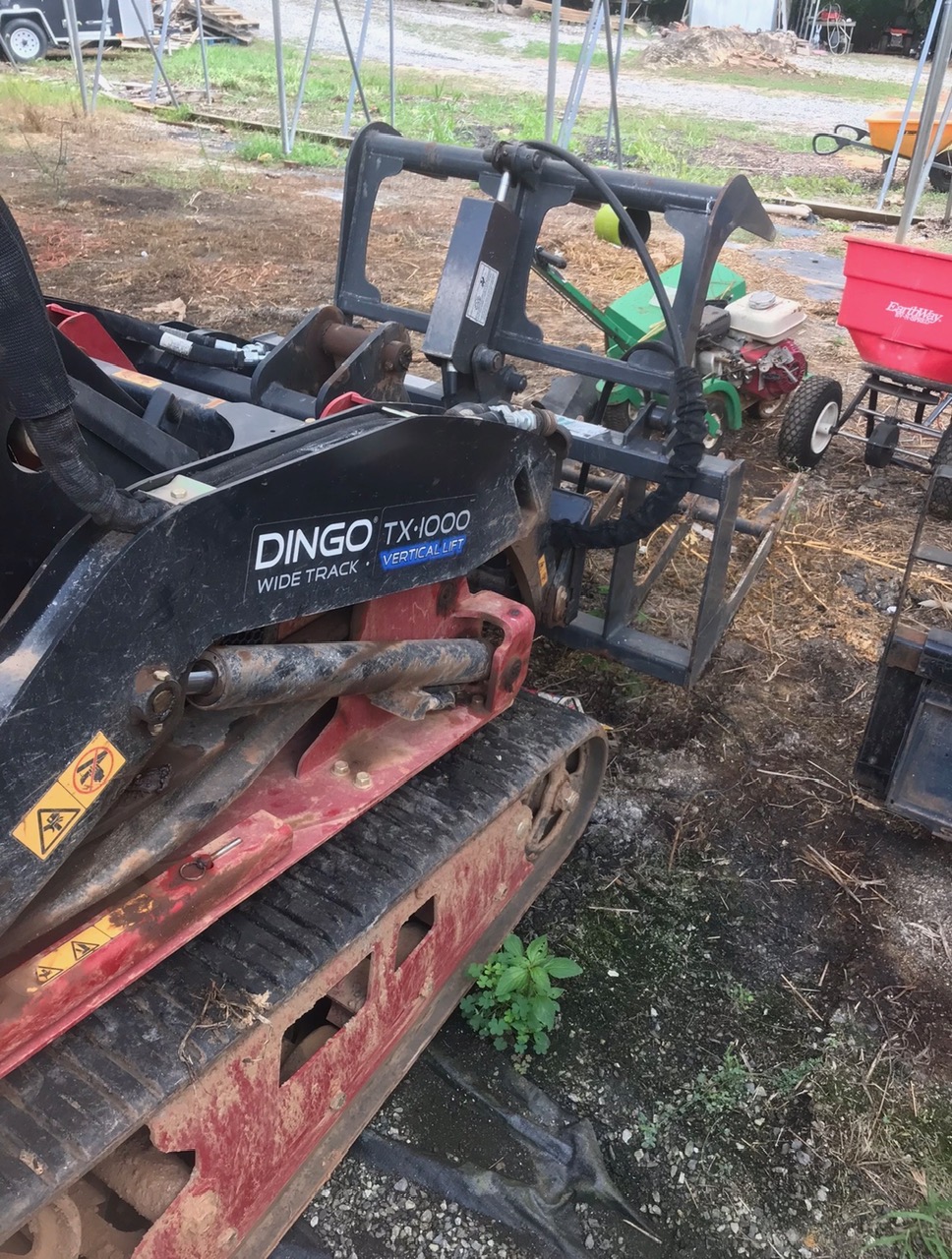
We also rent a Harley rake when we need one for certain soil-preparation, sod or seeding jobs rather than owning every possible attachment.
I would generally keep expensive or specialized attachments separate when job costing if their cost is specific to certain types of work. If I rent an attachment for one particular project, for example, that’s a straightforward direct job cost rather than something I need to bury inside every hour the Dingo operates.
The attachments are also a big part of why the machine has been valuable to us. One compact power unit can dig, trench, auger holes, carry material, move pallets and perform specialized work depending on what’s attached to it.
Would I Buy a Mini Skid Steer Again?
Absolutely.
For the type of contracting work we do, I definitely recommend having a mini skid steer if the workload justifies owning one.
The TX 1000 has been a very good machine for us. After approximately 3,500 hours, we’ve had no major engine or hydraulic-system problems, and we’ve been able to perform essentially all of the routine maintenance ourselves.
There is one tradeoff I notice more today than when we bought it.
The machine is rated around the 1,000-pound operating-capacity class. There are plenty of times I wish we had something more substantial that could comfortably handle a full pallet of heavy pavers or retaining-wall block.
But bigger equipment comes with its own compromises.
One of the reasons we love the Dingo is that it can get into tight backyard areas where a larger skid steer can be difficult or impossible to use. The wide tracks also help us work around established properties while minimizing turf damage compared with heavier equipment.
For us, that combination of accessibility, versatility and relatively simple maintenance has made the machine extremely useful.
The Bigger Lesson: Know What Your Equipment Costs Before You Price the Job
The most important number in this article isn’t $5.00 per hour, $6.89 per hour or even the original $35,000 purchase price.
The lesson is that equipment isn’t free just because it’s sitting in your shop, and it doesn’t become free when the loan is paid off.
If your jobs require trucks, skid steers, excavators, mowers, trenchers or other expensive equipment, those assets are consuming value while helping your crews produce work.
Your estimates need some consistent method of recovering that cost.
Start with the numbers you know. Estimate the ones you can reasonably support. Don’t pretend uncertain numbers are exact. Then compare your estimates with your actual results and improve the system over time.
For Our Dingo, Here’s What We Know
We paid about $35,000, have put approximately 3,500 hours on the machine, and believe it still has roughly $15,000–$20,000 of resale value.
Our reconstructable depreciation, replacement tracks, maintenance labor and major repair expense total approximately $6.89 per operating hour.
But $6.89 is a floor—not a complete equipment rate. Fuel, routine parts and fluids, insurance, future repairs and future replacement still have to be accounted for when deciding what the machine really needs to earn.
Frequently Asked Questions
How do you calculate equipment cost per hour?
Start by estimating the equipment’s depreciation or replacement cost over its useful operating hours. Then add hourly fuel, maintenance, repair, wear-item, insurance and other equipment-specific costs. The exact categories can vary depending on how your company handles overhead and job costing.
Should I include the equipment loan payment in my hourly rate?
A loan payment is important for cash flow, but it isn’t necessarily the same as the economic cost of using the equipment. Principal payments are paying for the asset itself, while interest is a financing cost. For our Dingo, the financing was 0%, so the payment did not increase the original purchase price through interest.
Does paid-off equipment still have an hourly cost?
Yes. Paid-off equipment can still depreciate, consume fuel, require maintenance and repairs, use insurance coverage and eventually need replacement. Treating paid-off equipment as free can cause a contractor to understate job costs.
Should equipment cost be included as a direct job cost?
If a piece of equipment is used specifically to perform a job, many contractors track an hourly or daily equipment charge as a direct job cost. The important thing is to use a consistent accounting method and avoid recovering the same expense twice through both equipment cost and overhead.
Should equipment attachments have their own cost?
It depends on the attachment and how it is used. A commonly used attachment may reasonably be incorporated into the equipment’s normal cost structure. A specialized rental or attachment used only for certain jobs may make more sense as a separate direct job cost.
Put the Numbers to Work
Use our free contractor calculators to better understand equipment costs, labor costs, job profit, markup, overhead, revenue goals and more.
Explore Free Contractor Calculators →