
How to Calculate Your True Labor Cost Per Hour: A Real Contractor Example
I used to look at an employee making $20 an hour and figure he probably really cost our company something like $23 an hour after payroll taxes and other expenses.
The problem was that I had no numbers to back that up.
Once I started looking closely at our actual payroll, overtime, paid time off, employer taxes, workers’ compensation and the number of hours an employee is truly producing work, I realized that hourly wage and true hourly labor cost are two very different numbers.
So I pulled a full year of payroll data for one of our hardscape employees and calculated what one productive hour of his labor actually costs our contracting business.
This article walks through the entire calculation using real 2025 payroll data from our company and shows how you can calculate the same number for your own employees.
What Is True Labor Cost Per Hour?
Your employee’s hourly wage is simply what you pay the employee for an hour of work.
Your true labor cost per hour is what that employee actually costs the company after employer-paid expenses and nonproductive paid time are included.
For a contractor, the number I care about most is even more specific: what does one productive hour of that employee’s labor cost my company?
That is the number I want when I am estimating labor for a job.
Most of our work is quoted as a lump-sum project, so customers normally never see an hourly labor rate. But behind the scenes, I still need a realistic hourly cost when I estimate how many labor hours a project will require.
My Real-World $20-Per-Hour Employee Example
This example uses one full calendar year of actual payroll data from one of our hardscape employees.
Actual 2025 Payroll Data
- Base hourly wage: $20.00
- Total paid hours: 2,243.19
- Regular hours: 1,913.87
- Overtime hours: 189.59
- Vacation hours: 91.73
- Holiday hours: 48.00
- Total gross wages: $46,759.70
This is already more useful than simply multiplying $20 by 2,080 hours, because this employee actually worked significant overtime and received paid vacation and holiday time.
Step 1: Start With Actual Annual Wages
For this employee, actual gross wages for 2025 were $46,759.70.
That amount includes regular pay, overtime pay, vacation pay and holiday pay.
| Payroll Category | 2025 Amount |
|---|---|
| Regular Pay | $38,277.40 |
| Overtime Pay | $5,687.70 |
| Vacation Pay | $1,834.60 |
| Holiday Pay | $960.00 |
| Total Gross Wages | $46,759.70 |
This is one reason I prefer using actual payroll reports whenever possible. Estimating someone’s cost from a $20 hourly wage can miss a meaningful amount of overtime and paid time off.
Step 2: Add Employer Payroll Taxes
The next expense is the employer’s share of payroll taxes.
For this employee, our 2025 payroll report showed:
| Employer Payroll Tax | 2025 Cost |
|---|---|
| Employer Social Security | $2,899.10 |
| Employer Medicare | $678.02 |
| Federal Unemployment Tax (FUTA) | $42.00 |
| NC State Unemployment Tax | $264.06 |
| Total Employer Payroll Taxes | $3,883.18 |
The employer Social Security and Medicare portion is commonly referred to together as employer FICA.
For most employees, the employer Social Security rate is 6.2% and Medicare is 1.45%, for a combined 7.65% on applicable wages.
Federal and state unemployment taxes work differently because they generally apply only to a limited wage base rather than every dollar an employee earns.
Step 3: Add Workers’ Compensation and Other Employee Costs
Payroll taxes are not the end of the calculation.
For this example, I am also including workers’ compensation insurance and uniforms.
Our workers’ compensation policy uses different classifications for different types of work. Hardscape and masonry work can carry a different rate than lawn maintenance work.
For this example, I am using an assumed 6% workers’ compensation rate for the hardscape employee. That is an illustrative rate for this calculation, not a published statement of our actual policy rate.
Six percent of $46,759.70 equals approximately $2,805.58.
I am also including approximately $200 per year for company-provided uniforms.
| Annual Employee Cost | Amount |
|---|---|
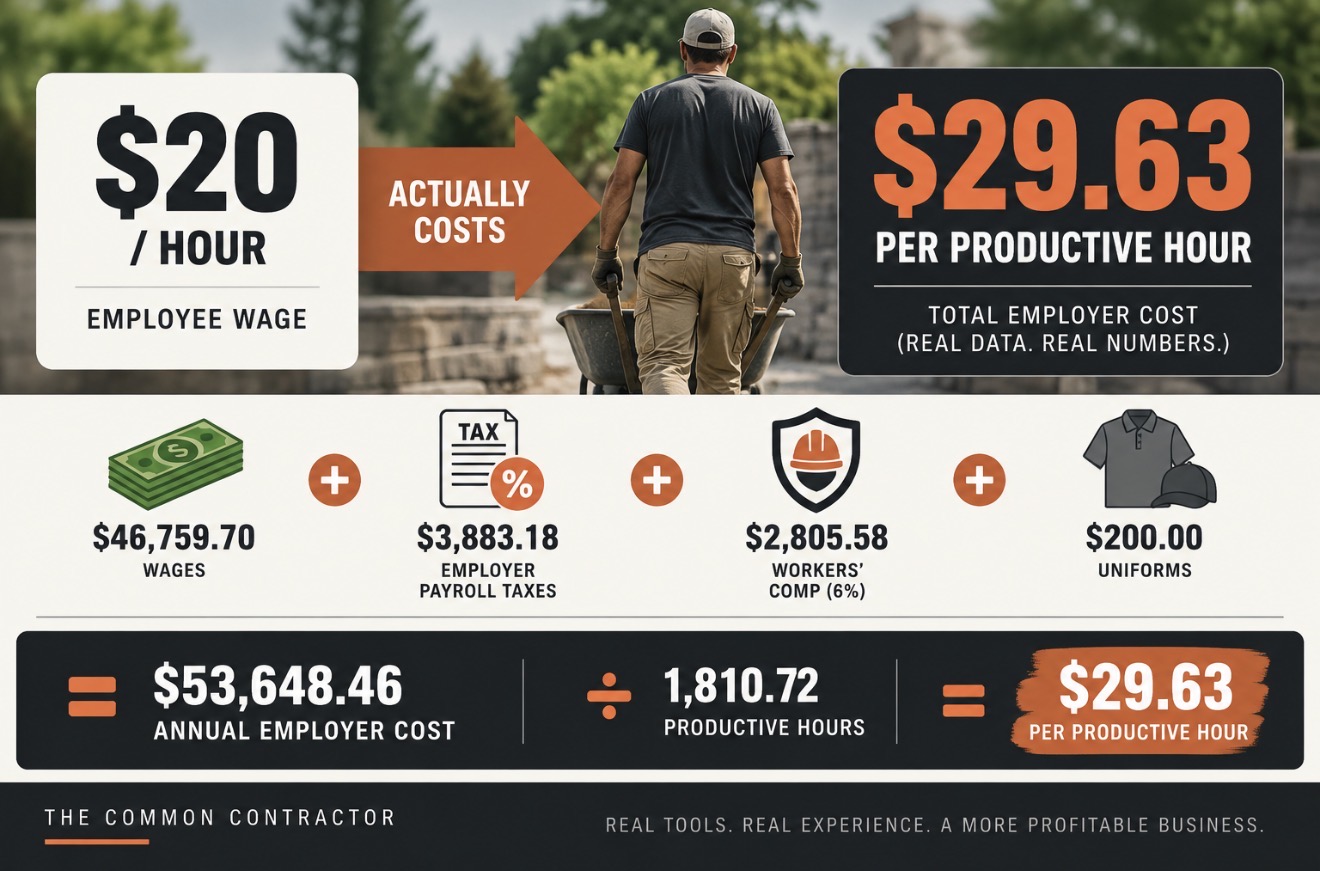
| Gross Wages | $46,759.70 |
| Employer Payroll Taxes | $3,883.18 |
| Workers’ Comp — 6% Assumption | $2,805.58 |
| Uniforms | $200.00 |
| Estimated Annual Employer Labor Cost | $53,648.46 |
If your company also provides health insurance, retirement contributions, bonuses, company phones, training, certifications or other employee-specific benefits, those costs can be added here as well.
Step 4: Paid Hours Are Not the Same as Productive Hours
This is the part of the calculation that I think contractors can easily overlook.
Our employee was paid for 2,243.19 hours during the year.
But 2,243.19 hours were not spent producing work on customer jobs.
His actual worked hours were:
- 1,913.87 regular worked hours
- 189.59 overtime worked hours
That equals 2,103.46 actual worked hours.
The remaining 139.73 paid hours were vacation and holiday hours.
Those hours still cost the company money, but obviously they do not produce work on a jobsite.
What Counts as a Productive Labor Hour in Our Company?
For this calculation, I consider an hour productive when it is reasonably associated with producing the work that generates revenue from a project.
That does not mean every productive hour involves physically installing something.
For our hardscape crews, I generally count normal drive time to and from the jobsite as productive.
I intentionally do that because I want some buffer in the estimate for the normal inefficiencies that happen in real contracting work: hot weather, an extra break, a small mistake, a task taking longer than expected or some other minor delay that I cannot predict perfectly.
In other words, I do not try to calculate productivity down to the minute.
I want a realistic number I can actually use to price work.
The Nonproductive Time I Account For
There is still paid work time that I do not consider productive job labor.
For this employee, I estimate approximately one hour per workday for things such as:
- morning shop preparation
- loading and unloading
- fueling trucks and equipment
- cleaning up at the shop
- washing or organizing equipment
- small maintenance tasks
- end-of-day shop time
We also have occasional meetings. Averaged across the year, I estimate those at roughly five minutes per workday.
Then there are things that happen simply because this is construction and outdoor work.
For this example I also allow approximately:
- 15 hours per year waiting through rain delays
- 15 hours per year dealing with equipment breakdowns
Based on the employee’s actual paid vacation and holiday time, I estimate approximately 242.5 worked days during the year.
| Estimated Nonproductive Worked Time | Hours |
|---|---|
| Shop/loading/fueling/cleanup — approx. 1 hr per worked day | 242.53 |
| Meetings — approx. 5 min per worked day | 20.21 |
| Rain delays | 15.00 |
| Equipment breakdowns | 15.00 |
| Total Estimated Nonproductive Worked Hours | 292.74 |
Step 5: Calculate Productive Labor Hours
We started with 2,103.46 actual worked hours.
Then we subtract approximately 292.74 nonproductive worked hours.
That means approximately 80.7% of all paid hours ultimately become productive labor hours under this method.
Another way to look at it is that roughly 86% of the employee’s actual worked hours are treated as productive after the nonproductive workday time is removed.
Step 6: Calculate the Effective Labor Cost Per Productive Hour
Now we finally have the two numbers we need:
- Estimated annual employer labor cost: $53,648.46
- Estimated productive hours: 1,810.72
Our Estimated Effective Labor Cost
A hardscape employee earning a $20 base wage costs our company approximately $29.63 for each productive labor hour under these assumptions.
That is almost 48% higher than the employee’s base hourly wage.
And that is the exact problem with estimating labor from wage alone.
Why My Old “$23 an Hour” Guess Was Wrong
Before I started calculating labor this way, my thinking was basically:
“If I pay him $20 an hour, he probably really costs me something like $23 after taxes and everything.”
There was no spreadsheet behind it. No annual payroll analysis. No productive-hours calculation.
It was just a guess.
And I was underestimating the cost.
The difference between $23 and $29.63 may not sound enormous until you multiply it by hundreds or thousands of labor hours across multiple employees and projects.
If a project requires 200 productive labor hours, for example:
- At $23/hour, estimated labor cost = $4,600
- At $29.63/hour, estimated labor cost = $5,926
That is a difference of more than $1,300 on one job.
Do that repeatedly and it can explain why a contractor looks busy all year but the profit at the end of the year does not match the amount of work performed.
How I Use Effective Labor Rate When Estimating Jobs
I do not normally give our customers an hourly labor price.
Most of our hardscape projects are quoted as a lump sum.
But I still need to know what labor costs internally.
If I estimate that a project will require 120 productive labor hours, I can use the effective labor cost rather than simply multiplying 120 hours by the employees’ wage rates.
That gives me a much more realistic estimated labor cost before I account for materials, equipment, overhead and the profit margin I want the project to produce.
The effective labor rate is therefore not necessarily the rate I charge the customer.
It is the internal cost number I use to help determine what I need to charge for the entire job.
Effective Labor Cost Is Not the Same as Your Customer Billing Rate
This distinction is important.
If an employee costs you $29.63 per productive hour, that does not mean you should charge the customer $29.63 per hour.
That amount only represents the estimated direct employee cost in this example.
Your selling price may also need to recover:
- company overhead
- vehicles
- equipment
- office staff
- insurance
- software
- rent or shop expense
- marketing
- owner compensation
- profit
Your labor cost and your labor selling rate are two different numbers.
How to Calculate Your Own True Labor Cost Per Hour
You can use the same process for your own employees.
- Pull one full year of payroll data if possible.
- Total regular pay, overtime pay, PTO and holiday pay.
- Add employer Social Security and Medicare.
- Add FUTA and state unemployment taxes.
- Add workers’ compensation.
- Add employee-specific benefits and expenses.
- Determine actual worked hours.
- Estimate paid work time that does not directly produce revenue.
- Calculate productive labor hours.
- Divide total annual employer labor cost by productive hours.
Don’t Want to Build the Math Yourself?
Use our free Effective Labor Rate Calculator to enter your wage, labor burden, annual hours and productive-time assumptions.
Use the Effective Labor Rate Calculator →What Percentage of Paid Hours Should Be Productive?
There is no universal percentage that applies to every contractor.
A service technician with windshield time between calls will have a different productive-hours percentage than a hardscape crew working several days at the same property.
A remodeling employee may spend time obtaining materials. A lawn maintenance crew may spend a significant portion of the day driving from one property to the next.
The important thing is to define productivity consistently for your own business.
In this example, productive hours came out to approximately 80.7% of total paid hours.
I also intentionally count normal hardscape drive time as productive because I want that allowance to provide some cushion for normal field inefficiencies that are difficult to predict perfectly.
Should Drive Time Count as Productive Labor?
That depends on how you price your work.
For our hardscape work, I generally count normal travel to and from the jobsite as productive for estimating purposes.
Another contractor may choose to classify that time as nonproductive and recover it through a separate overhead or travel factor.
Either method can work.
The bigger mistake is pretending the time does not exist.
Should PTO and Holidays Be Included in Labor Cost?
Yes, if the company pays for them.
Paid vacation and paid holidays are real employer costs even though those hours do not produce job revenue.
That is why I include the wages in annual labor cost but exclude those hours from productive labor hours.
Doing both is important.
What About Overtime?
Use the actual overtime cost whenever possible.
In this real example, the employee worked 189.59 overtime hours during the year and received $5,687.70 in overtime pay.
That is one reason I prefer using actual payroll reports rather than estimating annual cost from a standard 40-hour week.
What Is the Difference Between Labor Burden and Effective Labor Rate?
Labor burden generally refers to the employer-paid costs added on top of wages, such as payroll taxes, workers’ compensation and benefits.
Effective labor rate goes one step further by accounting for how many paid hours actually become productive hours.
That distinction matters because even a perfectly calculated labor burden can still underestimate job labor cost if every paid hour is treated as productive.
Related Free Contractor Calculators
You may also want to use these tools when building your labor and pricing system.
Contractor Labor Burden Calculator →
Employee True Cost Calculator →
Contractor Crew Day-Rate Calculator →
Contractor Job Cost Calculator →
The Number Does Not Need to Be Perfect to Be Useful
There is some estimation in this calculation.
I do not clock every minute an employee spends waiting on rain, loading a trailer or dealing with a broken piece of equipment.
I also intentionally make some judgment calls about what I consider productive time.
That does not make the calculation useless.
I would much rather estimate labor using a defensible number around $29.63 per productive hour than go back to saying, “He makes $20, so I guess he really costs me around $23.”
The objective is not to create a perfect accounting model.
The objective is to understand your labor well enough to price your work intelligently.
Final Takeaway
A $20-per-hour employee does not cost our contracting company $20 per hour.
Using one full year of actual payroll data, employer taxes and reasonable operating assumptions, this employee costs approximately $29.63 per productive hour.
That number gives me a much better foundation for estimating labor on lump-sum projects.
More importantly, it replaces guessing with numbers.
Put the Numbers to Work
Use our free contractor calculators to better understand labor costs, pricing, overhead, profit margins and more.
Explore Free Contractor Calculators →